Replacement Booth Covers: How to Measure, Order and Swap
How to measure restaurant booths for replacement covers and cushions, what to put in the order, how many spares to keep and how to swap covers without closing.
Planning seating for a venue? Send your floor plan or sizes and we'll quote from shop drawings, factory-direct.
Request a quote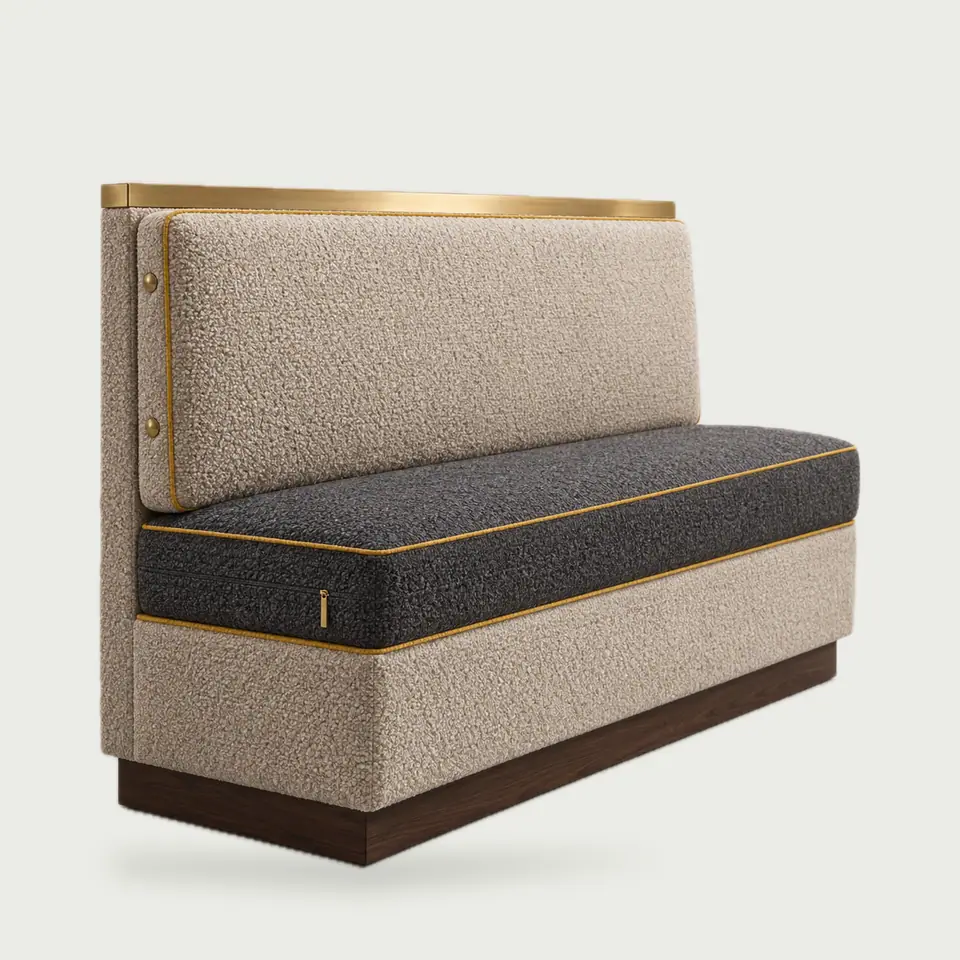
Short answer: Measure the booth frame, not the old cushions, and record width, depth, thickness, profile and closure position for every seat and back position, labelled on a plan. Order covers with the exact covering reference and dye lot, the zip or fixing type and a spare set from the same run. With loose cushions and zipped covers, a seat can then be swapped in minutes between services instead of waiting days for an upholsterer.
Removable covers only pay off if someone can actually get a matching replacement onto the booth on a Tuesday afternoon. That depends on three things most projects skip: an accurate record of sizes, a clear order specification and a simple changeover routine. This guide from Green Banquette (a line by EASEN Commercial Furniture) covers all three, whether your booths came from us or from someone else.
What exactly are you replacing?
Start by naming the part, because each one is measured and ordered differently.
| What you replace | When it makes sense | What you need to supply | Typical swap |
|---|---|---|---|
| Cover only (zipped) | Cover torn or stained, foam still firm | Cushion dimensions, profile, covering reference, zip position | Unzip, re-cover existing foam |
| Complete loose cushion (foam + cover) | Foam dipped or contaminated | As above, plus foam type and firmness | Unclip old cushion, fit new one |
| Seat front edge strip or end guard | Localized wear at the aisle or seat front | Part length, profile, fixing method | Unclip or unscrew, refit |
| Back panel (upholstered, cane, timber) | Back damaged or design refresh | Panel size, thickness, fixing points | Unscrew or lift off, refit |
| Fixed upholstery (stapled to frame) | No loose parts exist | Booth drawings or full measurements | Upholsterer strips and re-covers on site or in a workshop |
If your booths only have fixed upholstery, the first re-cover is the moment to convert them to loose cushions. Our guide on whether to reupholster or replace restaurant booths covers that decision.
How do you measure a booth for replacement covers?
Old cushions are compressed and stretched, so they are the least reliable source of sizes. Measure the space the cushion has to fill, then check against the old cushion.
Before sending your figures, sanity-check them against typical restaurant booth dimensions. A reading far outside these ranges usually means a measuring slip or a non-standard booth that needs a template:
| Dimension | Typical range (metric) | Imperial equivalent | If your figure is well outside it |
|---|---|---|---|
| Seat depth (deck, front to back) | 450–510 mm | 18–20 in | You may have measured the old, stretched cushion rather than the deck |
| Seat cushion thickness | 75–100 mm | 3–4 in | Measure at an unused corner, not the dipped centre |
| Overall booth height, floor to top of back | 900–1,070 mm | 36–42 in | High-back and screen booths run taller; check against the original drawing |
| Seat width allowed per diner | about 600 mm | about 24 in | Sets how many back pads a run needs and where the joints fall |
- Draw a simple plan of the room and number every booth position: B1-seat, B1-back-left, B1-back-right, and so on. Covers get labelled with these codes.
- Seat width: measure the seat deck from side to side, inside any arms or end panels, at the front, middle and back. Use the smallest figure if they differ.
- Seat depth: measure from the front of the deck to the back pad or back frame, at both ends and in the middle.
- Thickness: measure the original foam at the front and back edges, at an unused corner if possible. Seats are often thicker at the front than the back.
- Back pads: measure height and width of the area each pad covers, and the thickness at top and bottom.
- Profile: note rounded or square front edges, a sloped or wedge section, curved ends, cut-outs for posts or rails, and any channels or tufting.
- Curves and angles: for curved or angled booths, make a paper or card template of the seat deck. A photo of a tape measure along a curve is not enough.
- Closure and fixings: record where the zip runs (usually the back or underside edge), and how the cushion is held: studs, clips, hook-and-loop, hanging straps or screws. Photograph them.
- Trim details: piping or welt, contrast stitching, top-stitching and seam positions.
- Photograph each position straight on and from the side with the tape visible.
What to record per position
| Measurement | Seat cushion | Back pad | Why it matters |
|---|---|---|---|
| Width | Deck width at front, middle, back | Pad width | Too wide and the cushion bows; too narrow and gaps show |
| Depth or height | Front of deck to back | Top to bottom of pad | Controls how the run lines up |
| Thickness | Front and back edge | Top and bottom edge | Sets seat height and how full the cover looks |
| Profile | Edge shape, slope, cut-outs | Curve, bolster, wedge | A cover cut for the wrong profile never sits right |
| Closure | Zip side and length | Zip side and length | Hidden zips must stay hidden |
| Fixing | Type and positions | Type and positions | New cushion must engage existing fixings |
| Trim | Piping, channels, stitching | Same | Replacement must match the rest of the run |
Seat height under load is worth recording too. If guests already sit low, the replacement is the chance to add thickness or firmness, provided the table height still works.
What should the order specify?
A replacement order is only as good as its specification. Include:
- The parts list: position code, part, dimensions, profile and quantity for every item.
- Covering reference: manufacturer, collection, color and, where possible, the dye lot of the original. For customer's own material (COM), say who supplies it and when.
- Covering performance: abrasion data from the mill (Wyzenbeek double rubs or Martindale cycles), cleaning method, and any fire requirement that applies to your venue. Our comparison of wool, recycled polyester and plant-based coverings explains the trade-offs.
- Foam, if you are replacing complete cushions: type and firmness, plus any fire-performance requirement, since the composite of cover, interliner and foam is what gets tested.
- Closure: zip type, length and position, and whether you want a zip guard so it cannot catch on clothing.
- Fixings: matching the existing studs, clips or straps, or a stated change.
- Labels: position code sewn or printed inside each cover so it goes back in the right place.
- Spares: how many extra covers or cushions for the most-worn positions.
Our standard leather-look covering is a contract flame-retardant faux leather; genuine leather is available when you specify it and is quoted separately. Fire performance is always specified for the destination: for example CAL TB 117-2013 or BS 7176 where your project calls for it, with the material suppliers' reports; finished-item testing is quoted separately. Your fire marshal or building official decides what applies.
How many spare covers should you keep?
There is no universal number, but wear is never even. Aisle ends, booths by the entrance and the seats nearest the kitchen pass take far more traffic than corner positions. A practical approach:
- Identify the high-wear positions on your plan after a few weeks of service, or ask your floor team.
- Order spare seat covers for those positions with the original production run, from the same dye lot.
- Hold at least one spare back pad for each back pad size, since back pads are less interchangeable than seats.
- Store spares flat or loosely rolled, in a clean, dry, dark place, labelled with position codes.
- Rotate spares in during the first refresh so the stored covers age with the room rather than staying brighter than the rest.
Ordering spares later is possible, but a new dye lot can differ slightly in shade. If you reorder, plan to replace a whole run or a whole booth at once rather than a single cushion.
How do you swap a zipped cover?
On a well-made loose cushion, the swap is quick. The technique matters because forcing foam into a tight cover splits seams.
- Remove the cushion from its fixings and take it to a clean table, not the floor.
- Unzip fully and ease the cover off the foam, corner by corner.
- Check the foam: if it has a dip, a tear or a smell, replace the cushion, not just the cover.
- Check any fiber wrap or interliner around the foam; it should stay in place, because it helps the cover fill out and may be part of the fire-tested composite.
- Fold the foam lengthwise to slip it into the new cover, or wrap it in a thin plastic sheet that slides inside the cover and is pulled out once the foam is in.
- Seat the corners first, then work along the edges so seams sit on the edge of the foam, not over the top.
- Close the zip without trapping fabric or foam, and check the zip guard lies flat.
- Refit to the same position code and engage every fixing. Sit on it and check that the run lines up with its neighbors.
Before cleaning covers, read the mill's care instructions. A zipped cover is not automatically a washable cover: many contract fabrics are meant to be cleaned in place or professionally, and washing can shrink or fade them. Wash or clean a complete set together so shades stay even, and refit only when fully dry.
Can you change covers without closing?
Usually yes, if the work is planned:
| Situation | Changeover approach |
|---|---|
| One torn seat during service | Swap from spares between sittings; send the damaged cover for repair |
| Scheduled refresh of one area | Swap after close; refit and check before the next opening |
| Full color change | Swap covers zone by zone across several nights so seating never drops below what you need |
| Fixed upholstery being converted | Phase booths to an upholsterer or an on-site team, keeping the rest of the room open |
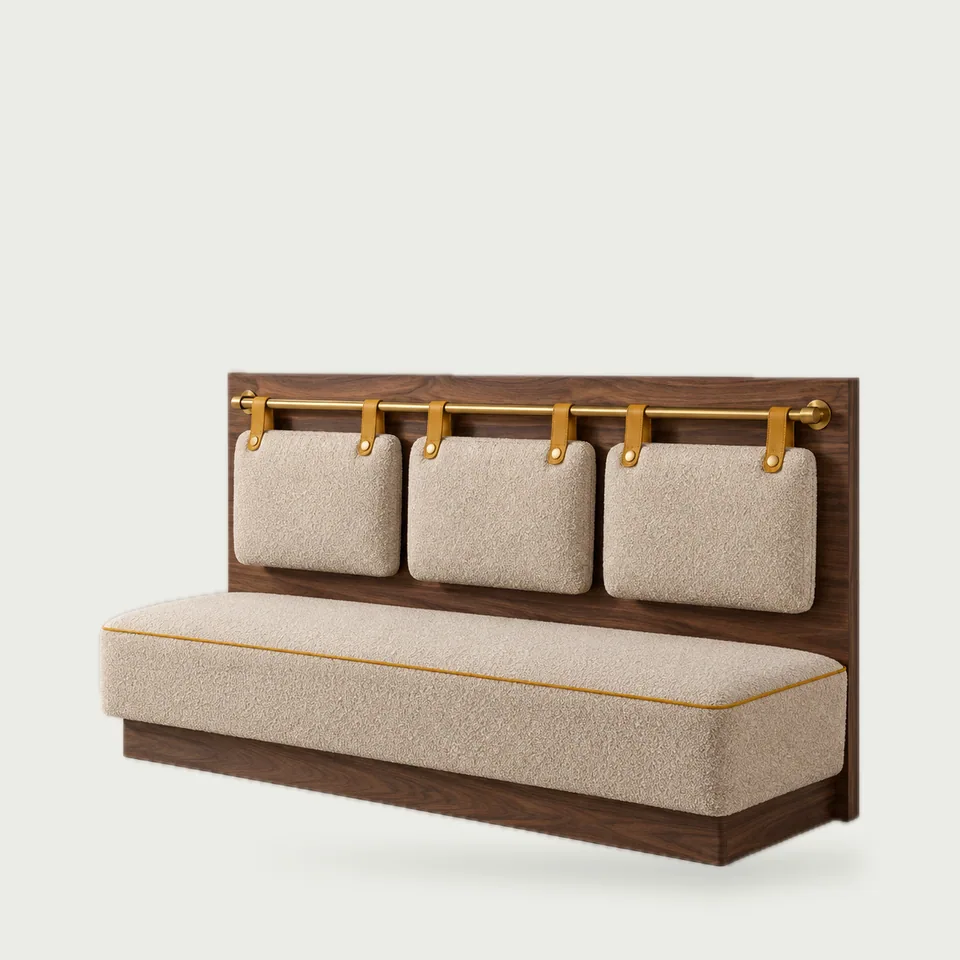
Booths designed for this make the routine simple. The Zip-Cover Booth uses loose seat and back cushions with zipped covers, the Rail-and-Cushion Booth hangs each back cushion on straps so one can come off on its own, and the Print Panel Booth Range has back panels you can swap for a new pattern. More examples are in our repair-ready booths collection, and the construction principles are set out in designing restaurant booths for re-upholstery.
Common mistakes
- Measuring the old cushion. It has been compressed and stretched for years. Measure the frame and the space.
- One measurement per seat. Decks are rarely square. Take three readings across each dimension.
- No position codes. Covers that look identical often differ by an inch (2–3 cm) or so; without labels they end up on the wrong seat.
- Ignoring dye lots. A single new cover in a run of old ones shows immediately.
- Changing the covering without checking fire performance. The new cover, the interliner and the foam work together.
- Machine-washing contract fabric. Check the care instructions first; shrinkage makes covers impossible to refit.
- Forcing foam into a tight cover. Seams split and corners twist. Fold or slide the foam in.
- Keeping spares in the cellar. Damp and light damage them before they are ever used.
Order replacement covers or a new repair-ready booth
Send us your position plan, the measurements and photos from this guide, the covering you want and the quantity of spares. We will turn them into a dimensioned parts list for your approval and quote covers, complete cushions or new repair-ready booths. Production typically takes 30–45 days for standard designs and 45–60 days for custom work after drawing and sample approval, plus transit; dates are confirmed in each quote. Get in touch through our contact page.
FAQ
Should I measure the old cushion or the booth?
Measure the booth: the deck and the space each cushion fills. Use the old cushion only to check thickness, profile and zip position, since it has been compressed by use.
Are zip-off booth covers washable?
Not automatically. Many contract fabrics should be cleaned in place or professionally. Follow the mill's care instructions and clean complete sets together.
Can I order replacement covers for booths I bought elsewhere?
We can quote them if you supply measurements, profiles, photos and fixing details for each position. Everything is confirmed in a parts list for your approval before production.
How many spare covers should a restaurant keep?
Enough for the high-wear positions, usually aisle ends and entrance-side booths, ordered with the original run from the same dye lot. Keep at least one spare per back pad size.
Do new covers affect fire compliance?
They can. The cover, interliner and foam are tested together, so specify replacement covers to the standard your venue requires and confirm with your fire marshal or building official.
What leather options do you offer for replacement covers?
Our standard is a contract flame-retardant faux leather. Genuine leather is available when you specify it and is quoted separately. We also accept customer's own material.
Tell us about your room, seat count and what matters most to you: longer service life, specific materials, lower shipping volume. We will reply with suggestions and an itemised quote.
Request a quote