Booth Cushion Replacement: When to Replace Restaurant Booth Seat Foam
Booth cushion replacement explained: signs restaurant seat foam has failed, CMHR foam density in kg/m³, hardness, fibre wrap, layered foam and swapping foam inside zip covers.
Planning seating for a venue? Send your floor plan or sizes and we'll quote from shop drawings, factory-direct.
Request a quote
Short answer: Replace restaurant booth seat foam when it bottoms out, keeps a permanent dip after guests stand up, or starts to crumble, even if the cover still looks good. In the UK, contract seating normally uses combustion-modified high-resilience (CMHR) foam, specified by density in kg/m³ and by hardness, and the replacement should match the original fire-tested build. With zip-off covers, the foam can often be changed inside the existing cover rather than re-covering the whole booth.
Foam is the part of a booth that guests feel first and that usually wears out first. Covers are visible, so they get attention; foam fails quietly, one sagging seat at a time, until a whole run feels tired. This guide from Green Banquette (a line by EASEN Commercial Furniture) explains how to tell when foam is finished, what the numbers on a foam specification mean, and how to replace it without throwing away good covers and frames.
What foam is used in restaurant booth seats?
Most contract booth seats in the UK use CMHR foam: a polyurethane high-resilience foam modified during manufacture to resist ignition. It is the usual starting point for seating that has to be assessed against BS 7176, the standard that sets the ignition-resistance level for upholstered seating in non-domestic settings using the test methods of BS 5852. Restaurants are commonly treated as medium hazard, which involves the cigarette and match sources plus the larger timber crib 5 source.
Two points matter for replacements:
- Fire performance belongs to the composite. BS 7176 results relate to the combination of cover, any interliner and filling that was tested, not to the foam alone. Swapping in a different foam, wrap or cover can change the result.
- Domestic rules are different. The Furniture and Furnishings (Fire) (Safety) Regulations 1988 cover furniture supplied for domestic use. Contract seating is normally specified under BS 7176, and the venue's fire risk assessment sits with the responsible person (in England and Wales under the Regulatory Reform (Fire Safety) Order 2005; Scotland and Northern Ireland have their own legislation).
We supply CMHR foams to the destination market's requirements on request with the foam supplier's reports; our BS 7176 medium hazard report (STC) covers our flame-retardant faux leather and foam, and testing of other builds at an independent laboratory is quoted separately.
What are the signs that booth seat foam needs replacing?
Foam rarely fails all at once. Check the busiest seats — usually those nearest the door, the window and the ends of runs — against a seat that sees little use.
| Sign | What you see or feel | What it usually means |
|---|---|---|
| Bottoming out | You feel the seat deck through the cushion | Foam has lost its support; replace |
| Permanent dip | A hollow stays after the guest stands | Compression set; replace the affected cushions |
| Front edge collapse | The seat front rolls down; covers wrinkle | Edge foam has softened; replace or add a firmer edge |
| Crumbling or dust | Yellowed, powdery foam when the cover is opened | Foam has degraded; replace and check neighbours |
| Uneven run | Seats in one run feel different heights | Mixed wear; replace in matched sets |
| Wet or contaminated | Odour, staining through, damp core | Spills soaked through; replace foam and check the cover |
A simple test: sit for a minute, stand up and look along the seat at eye level. A good cushion recovers to its full height within moments. If the dip is still there, or the cushion is visibly thinner than a spare or an unused seat, the foam is due.
What do foam density and hardness mean?
A foam specification usually gives two figures, and they describe different things.
Density (kg/m³) is the mass of foam per cubic metre. It is the best single indicator of how long a foam will keep its support. Contract seat cushions are commonly specified in the mid-30s to around 50 kg/m³; lighter foams tend to soften sooner under heavy daily use. Backs see far less load and can use a lower density.
Hardness (firmness) describes how hard the foam feels when you sit on it. In the UK and Europe it is usually given as an indentation hardness in newtons (N), measured by pressing an indenter into the foam to a set compression under BS EN ISO 2439. A higher figure feels firmer. In the US the same idea appears as ILD or IFD in pounds.
Suppliers often express a grade as density and hardness together, such as a "40/170" style code for 40 kg/m³ and 170 N. Grade names vary between foam makers, so always ask what each figure means rather than comparing codes across suppliers.
| Property | Unit | What it tells you | What to ask |
|---|---|---|---|
| Density | kg/m³ | Durability and support over time | The nominal density of the seat and back foams |
| Hardness | N (or lb ILD in the US) | How firm the seat feels | The test method and compression level used |
| Fatigue loss | % loss of hardness or height | How much the foam softens after repeated loading | Any fatigue result (for example to BS EN ISO 3385) |
| Fire classification | Test reference | How the composite performed | The report reference and the exact build tested |
Density and hardness are independent: a dense foam can be soft and a light foam can be firm. For restaurant seats, choose density for life, then hardness for comfort.
Fibre wrap and layered foam: are they worth it?
Most well-made booth cushions are not a single block of foam.
- Fibre wrap. A layer of polyester fibre or wool wadding wrapped around the foam, often in a stockinette sleeve. It softens the edges, helps the cover sit smoothly and makes the cushion look fuller. Wrap compresses over time, so a tired-looking cushion sometimes needs only a fresh wrap.
- Layered foam. A firmer, higher-density base layer for support with a thinner, softer layer on top for comfort. Layering gives a better sit than one medium foam, and the top layer can be replaced on its own.
- Firm front edge. A strip of firmer foam along the seat front resists the roll-down that makes booths look tired.
- Interliner or barrier. Some fire-tested composites rely on a barrier cloth between cover and foam. If yours does, the replacement must include it.
Every added layer is part of the fire-tested composite, so confirm the build before changing it.
Can you replace foam inside zip-off covers?
Yes, and it is one of the main reasons to specify loose cushions with zipped covers. If the covers are clean and sound, new foam can go into the existing covers, keeping the original fabric and dye lot on the floor.
- Record each cushion position on a plan of the booth run, numbered.
- Remove one cushion, unzip the cover and note the foam layers, wrap and any interliner.
- Measure the foam — width, depth, thickness and any profile — and compare with the frame, because old foam has shrunk.
- Order matched foam for the whole run, not just the worst seats, using the original specification where available.
- Fit the new foam into the cover with the wrap, working the corners in so the cover sits tight.
- Refit and check the seat heights along the run, and keep one spare cushion for quick swaps.
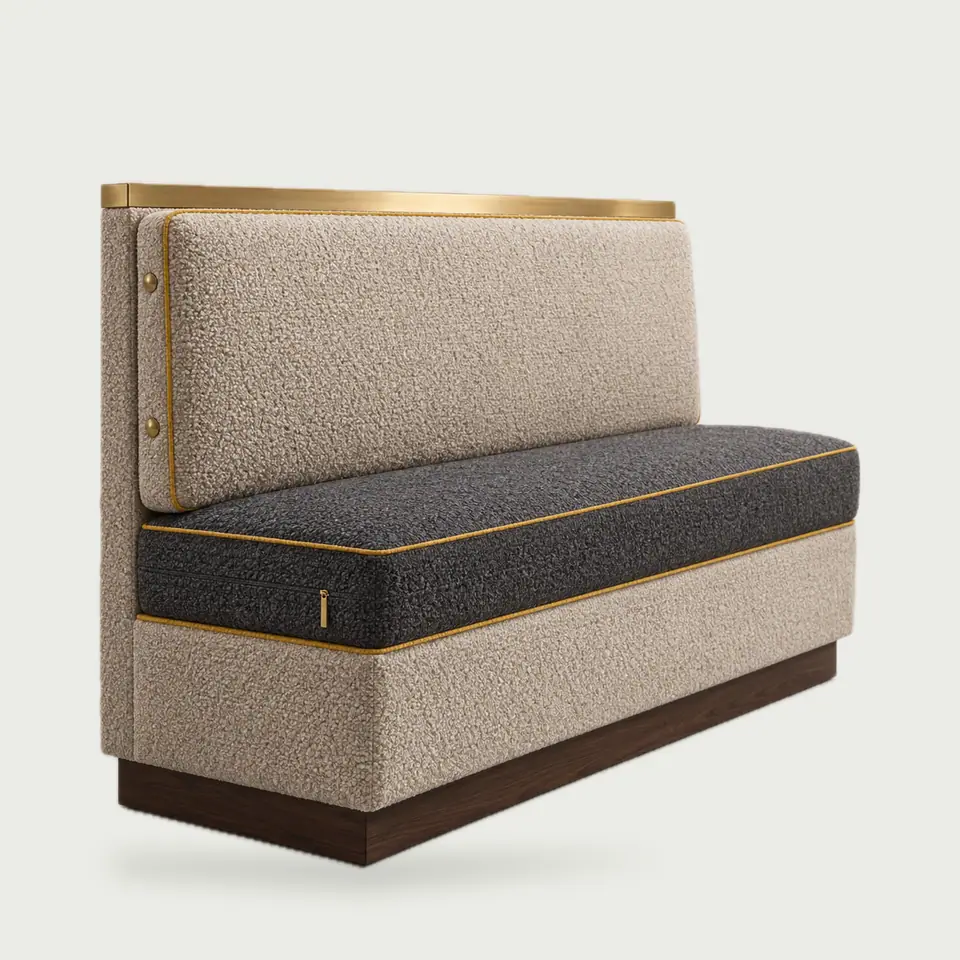
Our Zip-Cover Booth and Cane Loveseat with Loose Cushions are built this way, with a parts list issued with each order. For new or replacement covers at the same time, see our guide to measuring and ordering replacement booth covers.
Checklist: before you order replacement foam
- Identify which seats have failed and why (wear, spills or damage).
- Find the original foam specification and fire documentation.
- Confirm the fire requirement with your fire risk assessment.
- Choose density for life and hardness for comfort.
- Decide on wrap, layering and a firm front edge.
- Measure frames, not old cushions.
- Order the whole run, plus spares, from one batch.
Common mistakes
- Re-covering over dead foam. New fabric on tired foam looks good for weeks and then wrinkles and sags again.
- Replacing only the worst seats. New and old foam side by side feel like two different heights.
- Buying foam by thickness alone. Without density and hardness, you cannot compare quotes.
- Changing the composite without checking. A different foam, wrap or missing interliner can change fire performance.
- Over-stuffing covers. Too much foam strains zips and seams; too little lets covers slide and wear.
FAQ
How long does restaurant booth seat foam last?
It depends on density, hardness, how many covers a seat serves and how it is cleaned. Higher-density CMHR foam keeps its support longer than lighter grades. Rather than going by age, check the busiest seats regularly for bottoming out, permanent dips and edge collapse, and plan replacement when they appear.
What density foam is best for restaurant booth seats?
Contract seat cushions are commonly specified in the mid-30s to around 50 kg/m³. Higher density generally means longer life. Choose hardness separately for comfort, and make sure the foam you choose is part of a composite that meets the fire requirement for your venue.
Is CMHR foam required in UK restaurants?
Contract seating in UK restaurants is normally specified to BS 7176, commonly at medium hazard, and CMHR foam is the usual filling used to achieve that as part of a tested composite. The exact requirement comes from your fire risk assessment and specifier, so confirm it before ordering.
Can I replace the foam and keep my booth covers?
Yes, if the booth has loose cushions with zip-off covers and the covers are in good condition. Measure the frames, order matched foam for the whole run and fit it with fresh wrap. Fixed, stapled upholstery has to be stripped, which is the moment to consider converting to reupholsterable booths.
Should I add a fibre wrap to new foam?
Usually yes. A wrap smooths the cover, softens edges and makes the cushion look fuller. It must be included in the composite your fire documentation covers, so ask your supplier to confirm the full build — cover, interliner, wrap and foam — before fitting.
Tell us about your room, seat count and what matters most to you: longer service life, specific materials, lower shipping volume. We will reply with suggestions and an itemised quote.
Request a quote