Reupholster or Replace Restaurant Booths? A Decision Guide
Should you reupholster or replace worn restaurant booths? A frame inspection, decision table, lifespan by component and the real cost drivers of each route.
Planning seating for a venue? Send your floor plan or sizes and we'll quote from shop drawings, factory-direct.
Request a quote
Short answer: Reupholster when the frame is sound, the booth dimensions still suit your tables and layout, and only the covers and foam are worn; that is the case for most tired booths. Replace when the frame is failing (loose joints, a sagging deck, water damage at the base), when the layout or seat dimensions are wrong, or when the booths are so hard to strip that labor and downtime outweigh new seating. A 20-minute inspection of each booth type tells you which side of the line you are on.
Most restaurant booths are not thrown away because they are broken. They go because the vinyl has split along the seat front, the foam has dipped where regulars sit, or the room is being refreshed. This guide from Green Banquette (a line by EASEN Commercial Furniture) gives you a way to decide booth by booth, explains what drives the cost of each option without pretending there is a standard price, and shows how to make the next set of booths cheaper to refresh.
Which parts of a booth wear out first?
A booth is several components with very different service lives. The cover is consumable; the frame is not meant to be.
| Component | Relative service life | Typical signs it is done | Usual fix |
|---|---|---|---|
| Seat cover (vinyl or fabric) | Shortest; first to go | Cracks or splits at the seat front edge, peeling top coat, worn pile, stains that do not lift | Re-cover |
| Seat foam | Short to medium | A visible dip in the most-used positions; you feel the deck through the seat | Replace foam during re-cover |
| Back cover and back foam | Medium | Hair-product staining at head height, flattened upper back | Re-cover; foam often reusable |
| Wear edges, end panels, plinth face | Medium | Scuffs, chips and torn corners at aisle ends and kick height | Replace the part, or re-cover the end |
| Seat deck and webbing or springs | Long | Deck flexes or creaks, sag between supports | Repair or replace the deck |
| Timber finish, capping rails | Long; refinishable | Worn lacquer on rails and arms | Sand and refinish |
| Frame (hardwood, plywood, steel) | Longest; should outlive several covers | Racking, cracked joints, loose anchors, swelling or rot at the base | Repair joints; replace if structural |
The practical conclusion: a booth whose frame and deck are in good shape usually has several cover cycles left in it. The question is whether getting the old cover off and a new one on is quick or painful, and that depends on how the booth was built.
How do you inspect a booth before deciding?
Do this for each booth type in the room, not just the worst one.
Keep these reference dimensions to hand for the measuring steps below:
| Check | Typical reference (metric) | Imperial equivalent | What a miss tells you |
|---|---|---|---|
| Seat height under load | 450–460 mm | 18 in | If it is low with the old cover on, the foam or deck has failed, not just the cover |
| Table height | 740–760 mm | 29–30 in | Booth geometry was set against this; a new table height may mean new booths |
| Seat-to-table-top difference | 250–300 mm | 10–12 in | Outside this range guests sit too low or feel cramped, and re-covering will not change it |
| Accessible dining surface (US, ADA 2010 §902) | 710–865 mm high, 685 mm knee clearance | 28–34 in, 27 in | Relevant if the booth layout includes accessible seating positions |
| Base inspection zone | bottom 100 mm of the frame | 4 in | Where mop water collects and particleboard swells first |
- Rock test. Push the back firmly forward and back, then try to lift one end. Movement, clicks or creaks point to loose joints or failing anchors.
- Deck test. Kneel on the seat at each position. A deck that flexes, bows or creaks needs more than new foam.
- Base check. Look at the plinth and the bottom 4 in (10 cm) of the frame for swelling, soft spots, black staining or delaminating board. This is where mop water collects.
- Fixing check. Lift a corner of the seat cover if you can. Staples into a sound frame can be pulled; staples into crumbling particleboard mean the frame will not hold a new cover well.
- Dimension check. Measure seat height under load, seat depth and table height. A seat that is 2 in (5 cm) too low will not be fixed by new upholstery.
- Layout check. Ask whether the booths are in the right place. If you plan to move walls, add tables or change the concept, replacement may be part of a wider change anyway.
- Construction check. Note whether seat and back are separate parts, whether cushions are loose or upholstered to the frame, and whether the booth can leave the room through your doors.
Reupholster or replace: decision table
| What you found | Reupholster | Replace | Notes |
|---|---|---|---|
| Frame solid, covers split or stained | Yes | — | The classic reupholstery case |
| Frame solid, foam dipped | Yes, with new foam | — | Always replace seat foam when re-covering a dipped seat |
| Deck sagging, frame otherwise sound | Yes, with deck repair | Consider | Repairable if the frame holds fixings |
| Loose joints, frame racks | Only if joints can be re-glued and re-fixed | Often | Ask the upholsterer to quote the frame work separately |
| Base swollen or rotten from water | Rarely | Usually | Particleboard bases rarely recover |
| Wrong seat height or depth | — | Yes | Upholstery cannot fix geometry |
| Layout or concept change | Sometimes, if booths can be re-used elsewhere | Often | Modular frames can be re-arranged |
| Booths cannot be removed and cannot be stripped in place | Costly | Consider | Labor and closure time decide it |
| Fire requirement has changed | Yes, if the new cover and foam composite meets it | If the existing core cannot | Confirm with your fire marshal or building official |
What drives the cost of reupholstering a booth?
There is no standard price for reupholstery. These are the factors that make a quote higher or lower:
- How the booth comes apart. Covers stapled to the frame must be stripped staple by staple; loose cushions with zipped covers come off by hand. This is often the largest single labor factor.
- On site or off site. Re-covering on site avoids transport but means working in your dining room around service. Off-site work is faster per booth but leaves gaps in your floor.
- Foam replacement. New seat foam adds material and time; it is usually worth it, since a new cover over dipped foam wrinkles and looks tired within weeks.
- Covering choice and yardage. Contract vinyl, fabric with a large pattern repeat, channel or tufted backs all change how much material is cut and how many hours are sewn.
- Customer's own material (COM). You supply the covering; you still pay for labor, and the material must arrive on time and with its data sheet.
- Frame and deck repairs. Hidden damage often appears only when the old cover is stripped. Ask for frame work to be priced separately so surprises are visible.
- Batch size and phasing. Doing all booths of one type together is more efficient than one at a time, but you may need to phase work to keep the room open.
- Fire performance. If your jurisdiction requires a specific standard, such as CAL TB 117-2013, which many US specifications reference, or BS 7176 for UK contract seating, the new cover, any interliner and the foam have to be specified together.
What drives the cost of replacing booths?
Replacement has its own list, and the price of the booth itself is only part of it:
- Design and size. Straight runs cost less to make than curves, U-shapes and high channelled backs.
- Frame and materials. Solid hardwood and plywood frames cost more than particleboard and last much longer. Our guide to solid timber vs plywood vs MDF booth frames explains why.
- Freight and delivery. Booths ship by volume. Knock-down or bolt-together sections pack smaller.
- Removal and disposal of the old booths, which can be significant for fixed seating.
- Installation and any wall, floor or electrical work behind the old booths.
- Lead time and closure. New booths need drawings, production and transit. For Green Banquette designs, production typically takes 30–45 days for standard designs and 45–60 days for custom work after drawing and sample approval, plus transit; dates are confirmed in each quote.
What about downtime?
For a busy restaurant, the seats out of service often matter more than the invoice. Compare the two routes on closure as well as cost:
- Reupholstery can be phased overnight or on closed days, a few booths at a time, if the upholsterer works on site or you hold spare cushions.
- Replacement can be planned so that new booths arrive fully finished and go in during one short closure, provided the drawings were checked against the site.
- Repair-ready booths cut downtime for every future refresh: a torn seat cushion becomes a swap, not a closure.
Is there a middle route?
Yes, and it is often the best value. Keep the sound frames and change how they are upholstered. When the booths are stripped, an upholsterer can convert fixed seats into loose cushions with zipped covers, fit a separate seat front edge strip, and fix the back pads with clips or studs instead of staples. The first refresh costs more labor than a straight re-cover; the next ones cost much less, and you can keep a spare set of covers on the shelf.
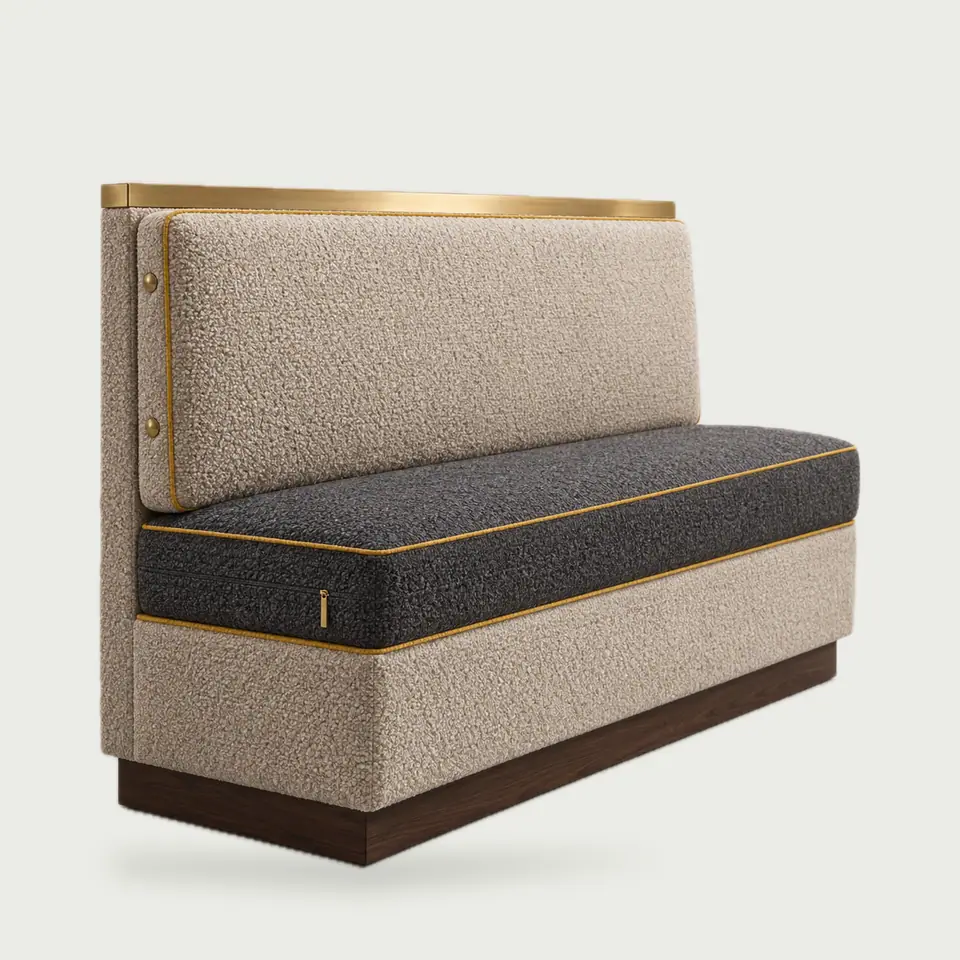
If you are replacing, specify the next booths so that this conversion is built in from day one: separate seat and back, loose cushions, zipped covers, bolted rather than glued joints, and a parts list with dimensions. Our repair-ready booths are designed this way, for example the Zip-Cover Booth, whose covers unzip for cleaning or replacement while the frame stays in place. Where the layout may change again, modular, bolt-together frames can be re-arranged rather than replaced. For the practical side of swapping covers, see replacement booth covers: how to measure, order and swap.
Checklist: before you decide
- Inspect each booth type with the seven checks above and photograph the results.
- Record seat height under load, seat depth, back height and table height.
- List which booths need covers only, covers and foam, or frame work.
- Ask your fire marshal or building official which standard applies to re-covered seating.
- Get a reupholstery quote with frame repairs and foam priced as separate lines.
- Get a replacement quote that includes freight, removal, disposal and installation.
- Compare closure days for each route, not just invoices.
- If you reupholster, ask about converting to loose cushions and zipped covers.
- If you replace, ask for a parts list and a spare cover set with the order.
Common mistakes
- Re-covering over dipped foam. The new cover wrinkles and the seat still feels worn. Replace seat foam at the same time.
- Judging from the worst booth. One water-damaged corner booth does not mean the whole room needs replacing.
- Ignoring geometry. If guests sit too low or too far from the table, fresh vinyl will not fix the complaint.
- Choosing a cover without checking fire performance. A new fabric over old foam can behave differently from the original composite.
- Replacing like for like. If the old booths were hard to strip, the new ones will be too unless you specify differently.
- No spare covers. Without a matching set on the shelf, the next tear means another call-out and another wait.
Get a reupholster-or-replace review
Send us photos of each booth type, the measurements from the checklist and a floor plan with your table sizes. We will tell you which booths are worth keeping, propose drawings for replacement or repair-ready booths where needed, and quote with every line visible. Start on our contact page.
FAQ
Is it cheaper to reupholster or replace restaurant booths?
Reupholstering is usually cheaper when the frame is sound and the booths can be stripped easily. It stops being cheaper when frame repairs, difficult disassembly or long closures pile up. Compare full quotes, including downtime.
How do I know if a booth frame is still good?
It should not rock or creak when pushed, the seat deck should not flex when you kneel on it, and the base should show no swelling or soft spots. Sound timber or plywood holds new staples or fixings firmly.
Should foam be replaced when booths are reupholstered?
Seat foam usually should, because it compresses with use and a new cover over dipped foam looks tired quickly. Back foam can often be reused if it has kept its shape.
Can booths be reupholstered on site?
Often, yes, if the upholsterer can work around service, for example overnight. Booths with loose cushions are the easiest; fully fixed upholstery may need to go to a workshop.
Does reupholstered seating have to meet fire codes?
In many jurisdictions, yes: the new cover and foam combination should meet the standard that applies to your venue, such as CAL TB 117-2013 where your specification references it. Ask your fire marshal or building official.
How can new booths be made easier to refresh?
Specify separate seat and back parts, loose cushions with zipped covers, replaceable wear edges, bolted joints and a parts list with dimensions, and order a spare cover set with the booths.
Tell us about your room, seat count and what matters most to you: longer service life, specific materials, lower shipping volume. We will reply with suggestions and an itemised quote.
Request a quote