Wool vs Recycled Polyester vs Plant-Based Leather: Restaurant Upholstery Compared (2026)
Natural and recycled restaurant upholstery compared: wool, recycled polyester, recycled cotton, plant-based leather and cork. Durability, fire behaviour and honest claims.
Short answer: Wool is the strongest natural choice for restaurant upholstery: it is harder to ignite than most fibres, chars rather than melts and resists soiling, but it costs more and some fire tests still require an interliner. Recycled polyester gives contract durability at moderate cost and uses a waste feedstock, but it remains a plastic and sheds microfibres. Plant-based leathers give an animal-free leather look but usually contain polyurethane. Whatever you choose, ask for the mill's data sheet and describe the material exactly as it states.
Fabric is the most visible material decision in a booth and the one most often described with vague environmental language. This guide compares the main options on durability, fire behaviour, cleaning and what can honestly be said about each.
What should a restaurant covering do?
Before any environmental attribute, a restaurant covering has to:
- Survive abrasion: commonly 40,000+ Martindale rubs for general contract seating, more for heavy use.
- Resist pilling (grade 4 or better) and seam slippage.
- Clean easily with the methods your team actually uses.
- Meet fire requirements as part of the composite with foam and any interliner.
- Hold its colour in light and to rubbing.
A covering that wears out in two years is not a good environmental choice, however it was made. Durability comes first.
The main options at a glance
| Material | Fibre source | Typical durability | Fire behaviour | Cleaning | Relative cost |
|---|---|---|---|---|---|
| Wool (100% or high-wool blend) | Renewable animal fibre | Very good | Hard to ignite, chars, self-extinguishing tendency | Resists soiling; spot-clean | Medium–high |
| Recycled polyester | Recycled PET or textile waste | Good to excellent | Melts and drips unless FR-modified or treated | Easy | Low–medium |
| Recycled cotton blends (e.g. denim) | Recovered cotton plus other fibres | Varies with blend | Cotton ignites readily; needs treatment or barrier | Moderate | Medium |
| Plant-based leather alternatives | Plant material plus PU binder on textile | Varies widely by product | Depends on formulation | Wipe clean | Medium–high |
| Cork (panels, not seats) | Bark of the cork oak | Good on backs and panels | Burns slowly, chars | Wipe, light sanding | Medium |
Wool: the natural performer
Wool is a protein fibre with high moisture content (its standard moisture regain is commonly quoted at around 15–16%, far above polyester's well under 1%) and a high nitrogen content. Together these make it harder to ignite than most textile fibres: it needs a higher oxygen concentration to sustain burning than cotton or polyester, its ignition temperature is high (commonly quoted at around 570–600 °C), and it tends to char and self-extinguish rather than melt and drip.
What that means in practice:
- Many wool upholstery fabrics pass the cigarette and match-flame tests (BS 5852 sources 0 and 1, EN 1021-1/-2) without chemical treatment.
- For BS 5852 crib 5, required for most UK restaurants under BS 7176 medium hazard, the result depends on the whole composite. Wool over combustion-modified foam with a suitable interliner is a common route; some wool fabrics use a flame-resistant finish instead.
- In California, CAL TB 117-2013 tests smoulder resistance; wool generally performs well, but it is the specific fabric and filling that are tested.
Wool also resists soiling because of its natural crimp and lanolin residues, recovers from compression and feels warm. Disadvantages: cost, potential for moth damage in storage, and the fact that bouclé and loose-weave wools can snag. Choose a tight weave with a published abrasion result.
Be careful with environmental claims: wool is renewable and can biodegrade under suitable conditions, but dyes, finishes and blends affect this, and sheep farming carries its own environmental impacts. Say what you can document: "100% wool face, untreated, fibre content per mill data sheet".
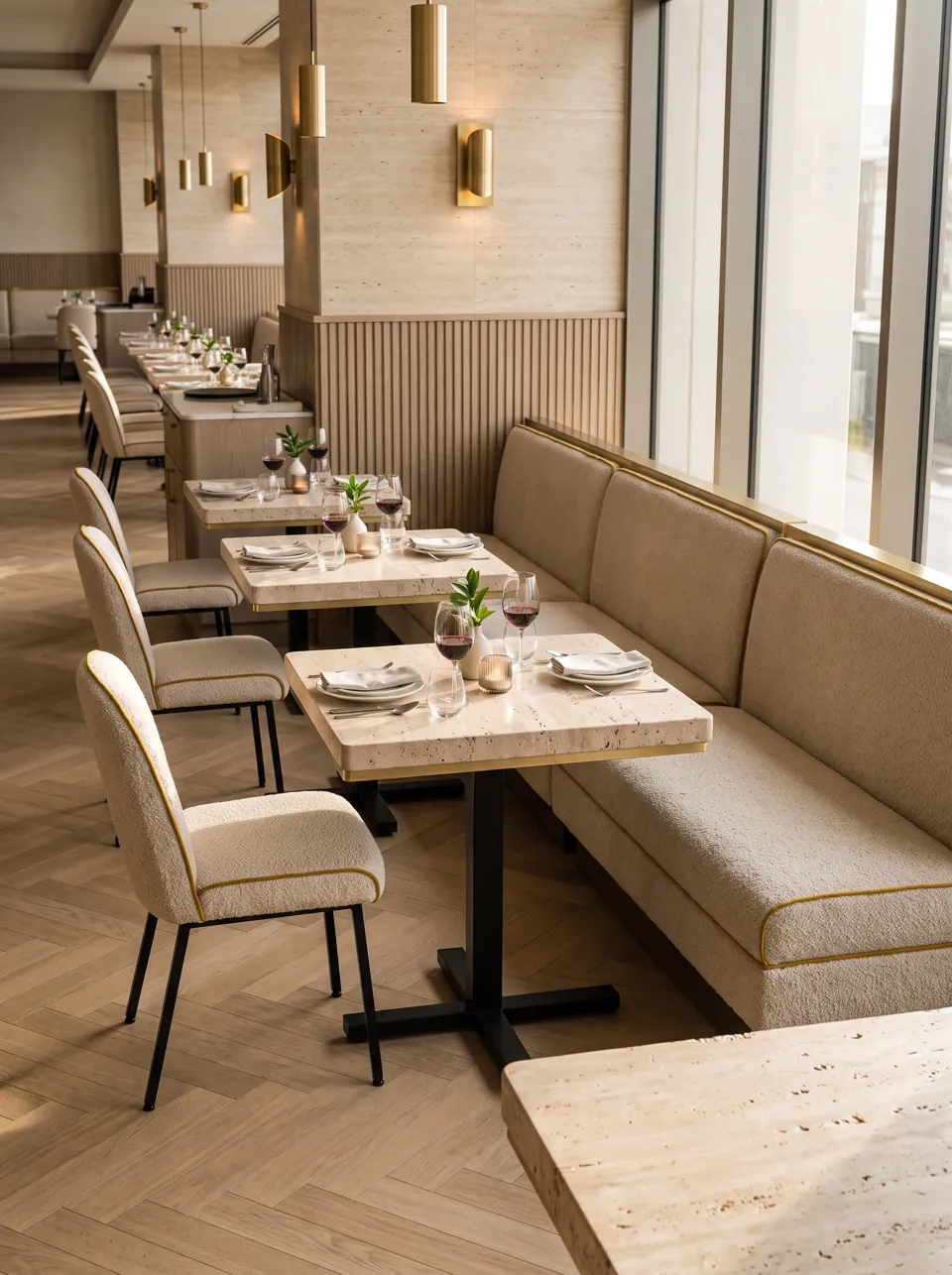
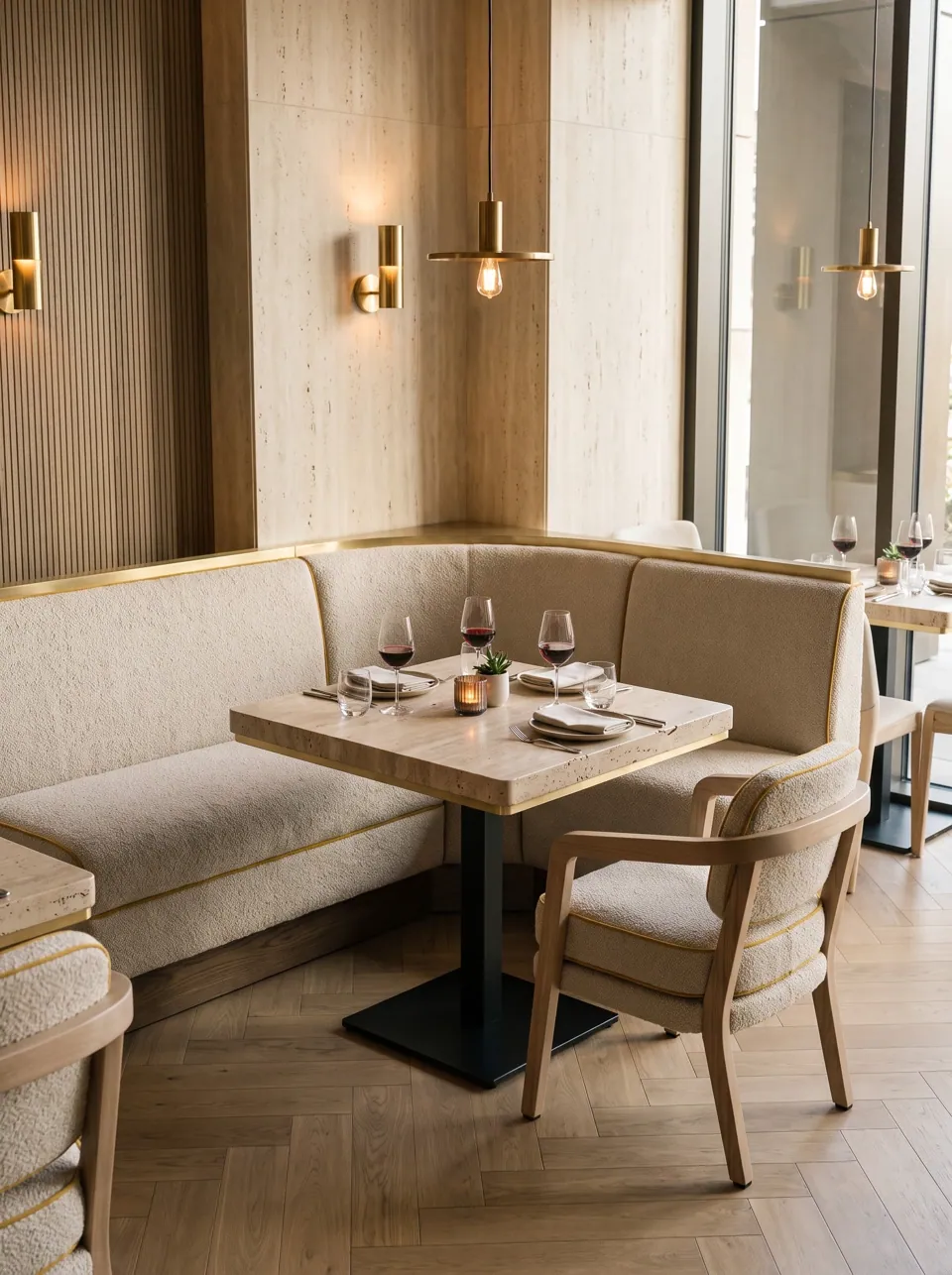
See our Pure Wool Booth.
Recycled polyester: durable and widely available
Most recycled polyester upholstery yarn is mechanically recycled from PET bottles, with a growing share from textile waste and chemically recycled feedstock. Contract weaves using it can match virgin polyester for abrasion and pilling.
Strengths:
- Proven contract durability at moderate cost.
- Uses a waste stream as feedstock.
- Easy-clean and colourfast.
Limits worth stating honestly:
- It is still polyester, a fossil-derived plastic, and sheds microfibres when abraded and cleaned.
- Recycling it again is difficult, particularly in blends and with back-coatings.
- Recycled content varies: a fabric may be 30% recycled or nearly 100%. The percentage must come from the mill.
- Standard polyester melts and drips in fire; contract fabrics either use inherently flame-retardant modified polyester, a back-coating or rely on an interliner.
Chain-of-custody schemes exist for recycled content, and mills that participate can provide transaction documentation. Ask for it if your project reports recycled content. Our Recycled-Content Polyester Booth is quoted with the mill's stated percentage only.
Recycled cotton and denim
Recycled cotton is recovered by shredding textile waste back into fibre. The fibres are shorter, so recycled cotton is usually blended with virgin cotton or polyester to give the yarn strength. The look can be lovely, with tonal variation and flecks, and the story is easy for guests to understand.
Check abrasion data carefully, because blends vary widely, and remember that cotton ignites more easily than wool or polyester: fire performance will rely on treatment or on an interliner and suitable foam. See the Recycled Denim Booth.
Plant-based leather alternatives
Materials marketed as cactus, pineapple-leaf, grape or apple "leather" are typically composites: plant material combined with a polyurethane or partly bio-based polyurethane binder or coating, on a woven or knitted backing. They give a leather look without animal hide.
Points to check:
- Composition: ask what share is plant-derived and what the binder is.
- Performance: abrasion, flex resistance, hydrolysis and cleaning data for contract seating.
- End of life: because of the polymer content, avoid calling them simply "biodegradable" or "compostable".
Mycelium-based leathers are promising but, at the time of writing, production remains limited; we do not quote them for project volumes.
Fillings matter as much as covers
The largest volume of material in a booth is the foam. Alternatives to standard polyurethane include natural latex (which may contain some synthetic latex, depending on the supplier), coconut coir, wool wadding and polyurethane foams with some recycled or bio-based content. Each changes weight, comfort, cost and fire behaviour, and the composite must be tested as a whole. See the Latex and Coir Cushion Booth.
How to choose: step by step
- Confirm the fire requirement for your market and building first.
- Set the durability bar: abrasion, pilling, cleaning method.
- Shortlist materials that meet both.
- Request data sheets with fibre content, recycled content and test results.
- Ask for chain-of-custody documentation if you plan to report recycled content.
- Sample the material on the real foam and test your cleaning products on it.
- Write your claims from the data sheet, word for word where possible.
Common mistakes
- Choosing on story rather than durability. A covering replaced in half the time doubles its material use.
- Assuming wool needs no fire planning. Crib 5 composites still need checking.
- Repeating marketing names. "Ocean plastic" or "vegan leather" can mislead without supporting evidence.
- Calling composite materials biodegradable. Most plant-based leathers contain polymers.
- Ignoring the foam. The filling is often the larger environmental and fire question.
- Mixing dye lots when ordering replacement covers.
FAQ
Is wool naturally fire-resistant?
Wool is naturally more flame-resistant than most textile fibres: it is hard to ignite, chars and tends to self-extinguish. It is not fireproof, and stricter tests depend on the whole composite.
Is recycled polyester as durable as virgin polyester?
Contract fabrics made with recycled polyester can achieve similar abrasion and pilling results. Check the specific fabric's data sheet.
Can I say my booths are made from recycled bottles?
Only if the fabric maker documents that the yarn is made from recycled PET bottles, and you state the percentage accurately, for example "seat fabric contains 60% recycled polyester from post-consumer bottles, per supplier data".
Are plant-based leathers better than real leather?
They avoid animal hide, but most contain polyurethane, and durability varies. Compare specific products on composition, performance and expected life rather than on category.
Which covering lasts longest in a restaurant?
Tight-weave wool and high-performance contract polyester are both very durable. Combine either with repair-ready construction so worn parts can be replaced individually.
Tell us about your room, seat count and what matters most to you: longer service life, specific materials, lower shipping volume. We will reply with suggestions and an itemised quote.
Request a quote